

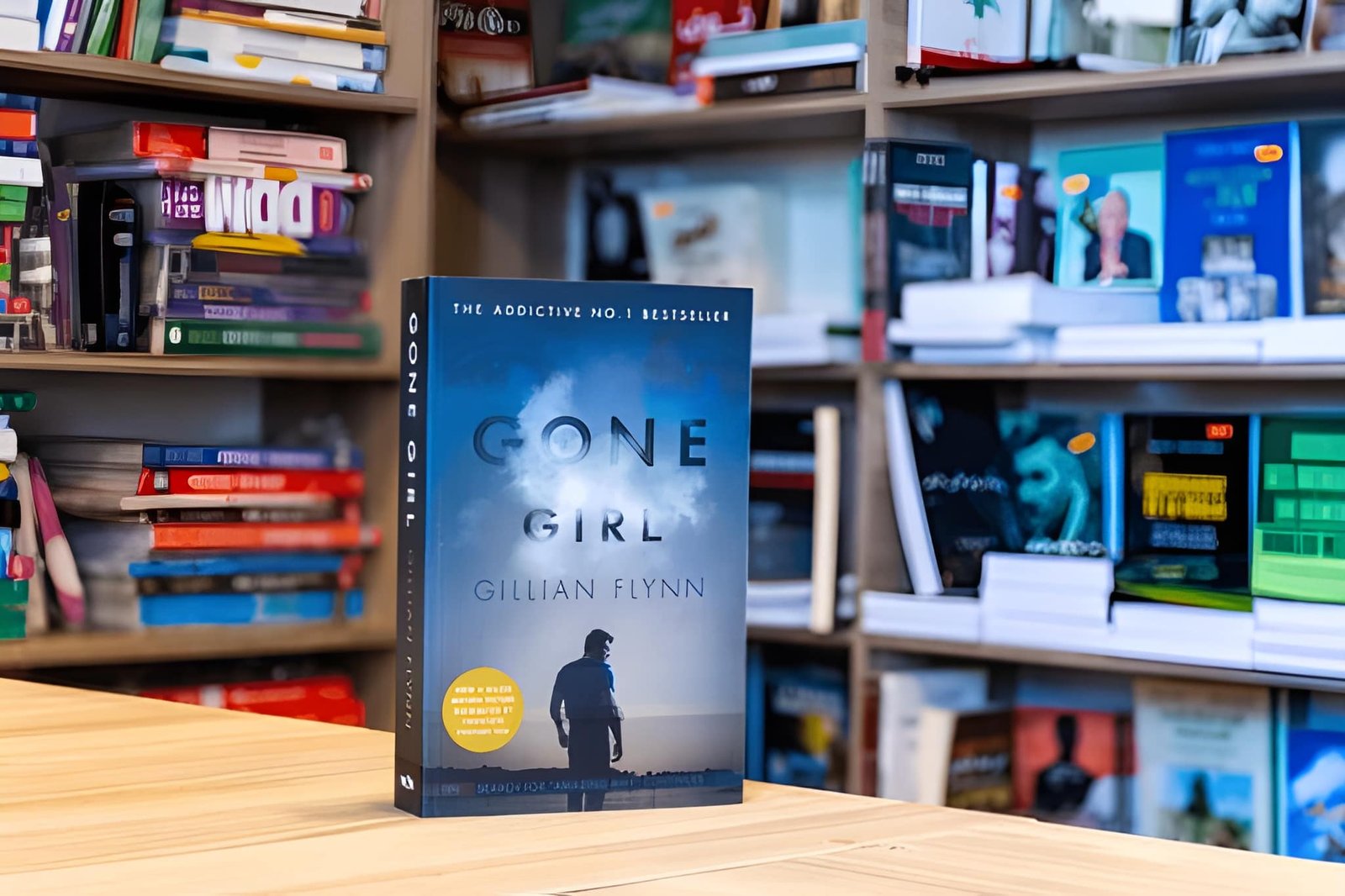
To write a book like Gone Girl, you need two unreliable narrators who deceive in fundamentally different ways, a marriage or intimate relationship that functions as a crime scene, a fabricated document that readers mistake for truth, social commentary sharp enough to cut beneath the thriller surface, and a protagonist so brilliant and monstrous that readers can’t stop reading even when they stop sympathizing. Flynn didn’t just write a thriller — she wrote a forensic examination of how people perform themselves for each other.
Gillian Flynn’s Gone Girl, published in 2012, didn’t just become a bestseller — it redefined an entire genre. Domestic noir, the psychological thriller subgenre built on the rot beneath respectable surfaces, had existed for decades. Gone Girl radicalized it. It introduced a female antagonist of such calculating intelligence and moral ferocity that readers didn’t know how to process her. It made a marriage a crime scene. It used the thriller’s architecture to ask questions about gender, performance, and the stories couples tell each other and themselves — questions sharp enough that the book still provokes furious argument more than a decade after publication.
Here is how it was built, and what you need to understand to write something in its tradition.
Make Your Two Narrators Unreliable in Completely Different Ways
The brilliance of Gone Girl lies not in having unreliable narrators, but in having two narrators who are unreliable in fundamentally incompatible ways. Flynn doesn’t just use unreliable narrators — she creates a masterclass in how they function. Nick’s unreliability stems from self-deception and social awkwardness, making him sympathetic despite his flaws. Amy’s unreliability is calculated manipulation, revealed gradually to devastating effect.
Nick omits information and misinterprets situations. He is unreliable, the way a person who lies to themselves is unreliable — not strategically, but psychologically. He doesn’t know what he’s hiding or why. He genuinely cannot see himself clearly. This type of unreliability generates sympathy even as it generates suspicion.
Amy fabricates entire personas. Her unreliability is not psychological blindness — it is deliberate architecture. She constructs her diary entries as evidence, as performance, as a trap. Her unreliability is active, where Nick’s is passive.
This distinction matters enormously. If both narrators deceived in the same way, the reading experience would be one of cumulative suspicion. Instead, the reader initially trusts Amy (her diary voice is warm, specific, vulnerable) and suspects Nick (his narration is evasive, guarded). The midpoint revelation inverts everything because it exploits that differential trust. The narrator, the reader believed, turns out to have been the most deliberate deceiver.
How to build your dual narrators:
Assign each narrator a distinct psychology of deception. One hides from others. One hides from oneself. One lies strategically. One lies because they cannot distinguish their version of events from reality. The more psychologically different their forms of unreliability, the more the narrative structure can do.
Make the reader’s sympathies shift — not just once but multiple times. In Gone Girl, the reader suspects Nick, then defends him, then learns Amy is alive, then suspects Nick again through new eyes, then is compelled into a horrible intimacy with Amy’s genius. Each shift requires preparation and a specific trigger. Map those triggers before you draft.
Build the Fabricated Document That Reads as Truth
Amy’s diary is the novel’s most sophisticated structural device. It is also a fabrication — written not as a genuine record of her inner life but as a piece of evidence designed to frame Nick for her murder. Flynn employs Amy’s diary entries as a deceptive tool to manipulate perceptions of truth.
The genius of this device is that it mirrors something true about how diaries work. Readers trust diary entries the way they trust confessions — these feel like direct access to interior life, unmediated by performance. Flynn exploits that trust completely. Amy knows readers trust diaries. She uses that knowledge.
The diary entries in Part One work because they are written with emotional specificity and social texture that feels real. They contain the kind of minor, unflattering detail that seems incompatible with invention. They show vulnerability that seems incompatible with manipulation. They describe a deteriorating marriage from the inside with an intimacy that feels like genuine pain.
On rereading, every element of that apparent authenticity is revealed as craft. The vulnerability is calculated. The unflattering details are planted to build credibility. Intimacy is a trap. Flynn uses the document that feels most like the truth as her most thoroughgoing lie.
How to build your fabricated document:
Ground it in the specific textures of emotional truth — the petty frustrations, the small humiliations, the moments of unexpected tenderness — that make it feel unliterary and therefore genuine. Real diaries are messy and contradictory. Your fabricated diary must appear messy and contradictory while actually being completely controlled.
Plant the seeds of the revelation within the document itself. On a first reading, these details are texture. On a rereading, they are evidence that the narrator knew what they were doing. Flynn achieves this throughout: details that seemed to characterise Amy’s marriage turn out to have been information about the crime she was planning.
Write the Relationship as the Crime Scene
Gone Girl belongs to a tradition that traces back through Rebecca and Gaslight — the domestic thriller in which the most dangerous place a person can be is their own home, with their own partner. But Flynn advances this tradition by refusing to make the danger unidirectional. Where classical domestic suspense often portrayed women as victims of male manipulation, Gone Girl creates a more complex dynamic where both spouses become predator and prey simultaneously.
Nick and Amy’s marriage is not a crime scene in the conventional sense — no body is found there, no blood is shed. It is a crime scene in the psychological sense: the site where two people performed selves for each other rather than being selves, where resentment calcified into violence under the pressure of economic collapse and forced relocation. The abandoned McMansions in their Missouri neighborhood symbolize this fallen American Dream, providing a fitting backdrop for a marriage that has similarly become an empty shell.
The marriage’s deterioration is not backstory. It is the mechanism of the thriller. Nick’s affair, Amy’s dissolution of herself into performed versions of the “Cool Girl,” their mutual dishonesty — these are the conditions that produce the crime. The domestic space generates danger.
How to write the relationship as your crime scene:
Make the history of the relationship the history of the threat. The events that lead to the crime should emerge from the specific dynamics of this specific relationship — not from external circumstances that happen to characters who could have been anyone.
Give both partners something real to resent. Audience sympathy is not required, but audience comprehension is. The reader should understand, even while rejecting, why each character makes the choices they make. Resentment that makes psychological sense is far more disturbing than resentment that seems arbitrary.
Make Your Villain a Social Critic
The most radical thing Flynn does in Gone Girl is give Amy — her calculating, murderous, entirely unreliable antagonist — some of the sharpest social commentary in the novel. The “Cool Girl” monologue is the most famous example: Amy’s articulation of the performed femininity she enacted for Nick, the exhausting labour of pretending to be easy and fun and uncomplicated while actually being a person with desires and frustrations and preferences.
This passage works on two levels simultaneously. It is Amy’s self-justification — she is explaining why her rage is legitimate, why her revenge is proportionate. It is also an astute cultural observation about the performance of gender in heterosexual relationships that resonates with readers, independent of whether they agree with Amy’s response to that performance.
Flynn grants her villain the novel’s most intellectually credible voice. This is a significant and deliberate craft choice. It prevents the reader from achieving comfortable moral distance from Amy. She is monstrous, and she is right about some things. That combination — genuine insight into a genuinely dangerous person — is what makes her impossible to dismiss and impossible to fully endorse.
How to write a villain with social intelligence:
Give them a critique that has genuine validity independent of their actions. The critique should be legible and even partially correct without justifying what they do with that insight. The reader should be able to hold both things simultaneously: this person is right about something, and this person is doing something wrong.
Let the villain name what the narrative shows rather than what it tells. Amy’s Cool Girl speech makes explicit something that the entire first part of the novel has been demonstrating through Nick’s expectations and Amy’s accommodations of them. The monologue lands with force because it articulates what the reader has been watching.
Write the Dark Ending Without Resolution
Gone Girl‘s final pages are a masterpiece of tonal control. Nick and Amy end the novel together — not reconciled, not loving, but locked into a codependency that is worse than either conflict or separation. Victory is another form of confinement. Nick cannot leave because Amy is carrying his child. Amy cannot leave because Nick is the only audience for her genius. They are trapped in a performance for which there is no exit.
Flynn refuses the comfort of any resolution — legal punishment, escape, redemption, or clean hatred. The ending is not ambiguous in the way Verity‘s ending is ambiguous — the reader knows exactly what happened and exactly what will continue to happen. The horror is not uncertainty. It is clear: this is what these two people are, and this is how they will continue.
How to write a dark ending that earns its bleakness:
Make the ending feel psychologically inevitable, given who these characters are. Nick and Amy end together because their characters — his passivity, her need for an audience, their shared inability to perform for anyone else — make any other outcome impossible. The ending should feel like the only place this specific story could have gone.
Deny the reader the emotional release of conventional thriller closure. No arrest. No escape. No redemption. Something more disturbing: continuation.
Summary: Key Elements of Writing a Book Like Gone Girl
| Element | What To Do |
|---|---|
| Dual unreliable narrators | Different psychologies of deception — one passive, one strategic |
| Fabricated document | Ground lies in emotional specificity; plant revelations as texture |
| Relationship as a crime scene | The domestic history generates the threat |
| Villain with social intelligence | Give them insight that is valid, but does not justify their actions |
| Dark ending | Psychological inevitability, no conventional closure |
| Social commentary | Let the thriller carry ideas that matter beyond the plot |
Writing a book like Gone Girl means refusing to choose between entertainment and intelligence — between a propulsive thriller and a sharp cultural diagnosis of how people perform themselves inside intimate relationships. Flynn didn’t compromise between those goals. She built a novel where they are the same thing. The deception is the commentary. Marriage is a crime. The structure is the argument.
That kind of integration — where form and content are inseparable — is the highest ambition in psychological thriller writing. It is also what makes Gone Girl genuinely difficult to imitate and genuinely worth studying.
Frequently Asked Questions
What genre is Gone Girl?
Gone Girl is a domestic noir psychological thriller — a subgenre that uses the intimate space of marriage and domestic life as the site of danger, deception, and violence, rather than the external world of crime or adventure.
What makes Gone Girl different from other psychological thrillers?
Most psychological thrillers use unreliable narration to hide the truth from readers. Gone Girl goes further: one of its two narrators doesn’t just hide the truth — she constructs an entirely fabricated reality, presented as fact, for the first half of the novel. The deception is not evasion. It is performance.
How long is Gone Girl?
Approximately 145,000 words across three parts, with chapters alternating between Nick’s first-person present-tense narration and Amy’s diary entries.
