

Writing a book is one of the most rewarding things a person can do — but finishing one is where most people fail. Studies show that 97% of people who start writing a book never complete their first draft. The difference between those who publish and those who quit isn’t talent. It’s strategy, habit, and knowing the rules that bestselling authors follow.
This guide walks you through every stage of writing a book that doesn’t just get finished — but gets read, recommended, and remembered.
Start With a Validated Idea
Before writing a single word, make sure your idea has an audience. Bestselling books solve a real problem, answer a burning question, or deliver an emotional experience readers are already craving.
- Research the top 10 books in your genre on Amazon and read the one-star reviews — that’s where readers tell you exactly what’s missing
- Write a one-sentence pitch: “This book is for [reader] who wants [outcome] without [pain point]”
- Test your concept with 5–10 real people in your target audience before you commit months of work
- Identify your unique angle — what can you say that hasn’t already been said better?
Know Your Reader Before You Write a Word
Amateur writers write for themselves. Bestselling authors write for one specific, clearly imagined reader. According to Publisher’s Weekly, books that speak directly to a defined audience consistently outperform broadly targeted titles in both sales and word-of-mouth.
- Build a reader avatar — their age, fears, goals, and the question they most want answered
- Write as if speaking directly to that one person throughout every chapter
- Use the language your reader uses — spend time in online forums, subreddits, and book reviews in your niche
- Anticipate every objection or question they’ll have as they read
Structure Your Book for Momentum
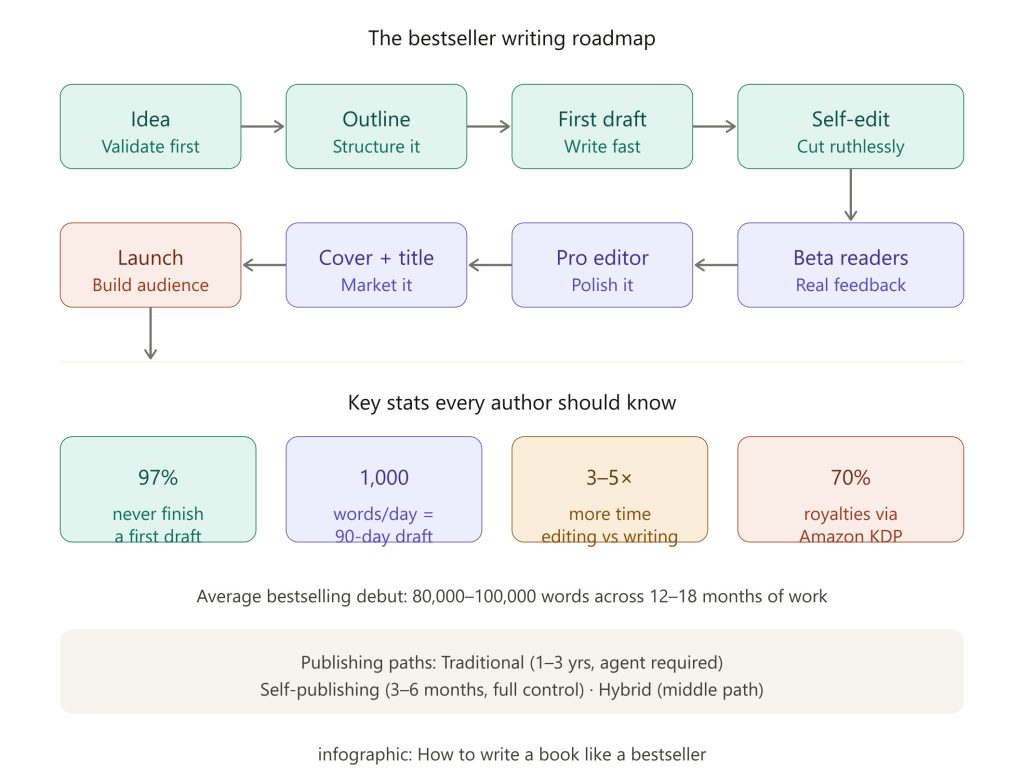
The infographic above maps your entire book-writing roadmap — from idea validation to launch — alongside key stats to keep in mind throughout the journey.
Build a Writing Habit That Actually Sticks
The single biggest reason books don’t get written is the absence of a reliable system. According to Reedsy, the average author takes 6 to 12 months to write a book — not because it takes that long, but because most people write inconsistently. Writing 1,000 words a day gives you a full 90,000-word first draft in just 90 days.
- Write at the same time every day, even for 30 minutes — consistency beats marathon sessions every time
- Set a word count goal, not a time goal — it creates a clear, achievable daily win
- Never edit while drafting — get the messy first draft done before your inner critic wakes up
- Track your daily streak visually — seeing momentum builds more momentum
- Remove all friction — keep your manuscript open and ready, so starting takes zero willpower
Write Your First Draft Without Perfectionism
The first draft is not supposed to be good. It is supposed to exist. Perfectionism at the drafting stage is the single most common reason talented writers never finish their book.
- Give yourself full permission to write badly — brilliance lives in revision, not in first attempts
- Leave placeholder notes like “[EXPAND HERE]” or “[FIND STAT]” and keep moving forward
- Do not go back and reread previous chapters while you are still drafting
- When you feel stuck on a section, skip ahead to one that excites you and return later
Edit Like an Editor, Not a Writer
The real book gets built in the editing phase. Bestselling manuscripts are edited three to five times more than they are written. This is where most self-published books fall short — and where traditionally published books earn their edge.
- Take at least one full week away from your manuscript before your first editing pass
- Read the entire book aloud — your ear catches what your eye overlooks
- Cut every sentence that does not advance the reader’s understanding or journey
- Recruit beta readers from your actual target audience, not your social circle
- Hire a professional developmental editor — no published bestseller skipped this step
Title, Cover, and Positioning
A great book with a forgettable title and a weak cover will underperform every time. These elements are not cosmetic. They are the primary reason a reader clicks — or doesn’t.
- Your title should promise a clear outcome or trigger genuine curiosity
- Study the top 20 book covers in your genre — yours must fit in and stand out simultaneously
- Write your back cover blurb or Amazon description before you finish the manuscript — it sharpens your core premise
- Test two or three title options with your target audience using a quick online poll
Think About Publishing Before You Finish
Your publishing path shapes how you write, market, and launch your book — so it should be decided early, not as an afterthought.
- Traditional publishing requires a literary agent and typically takes one to three years, but offers credibility and bookstore distribution
- Self-publishing through platforms like Amazon KDP gets your book to market in three to six months with royalties as high as 70 percent
- Hybrid publishing sits in the middle — some editorial and distribution support with faster timelines
- Begin building an email list and social audience before launch day — even 1,000 engaged readers can drive a successful debut
The Bottom Line
Writing a bestselling book is not about waiting for inspiration or possessing extraordinary talent. It is about knowing your reader, following a repeatable system, and editing without ego. The authors who succeed show up every day — whether they feel like it or not. Start writing today. Your reader is already out there waiting.
