

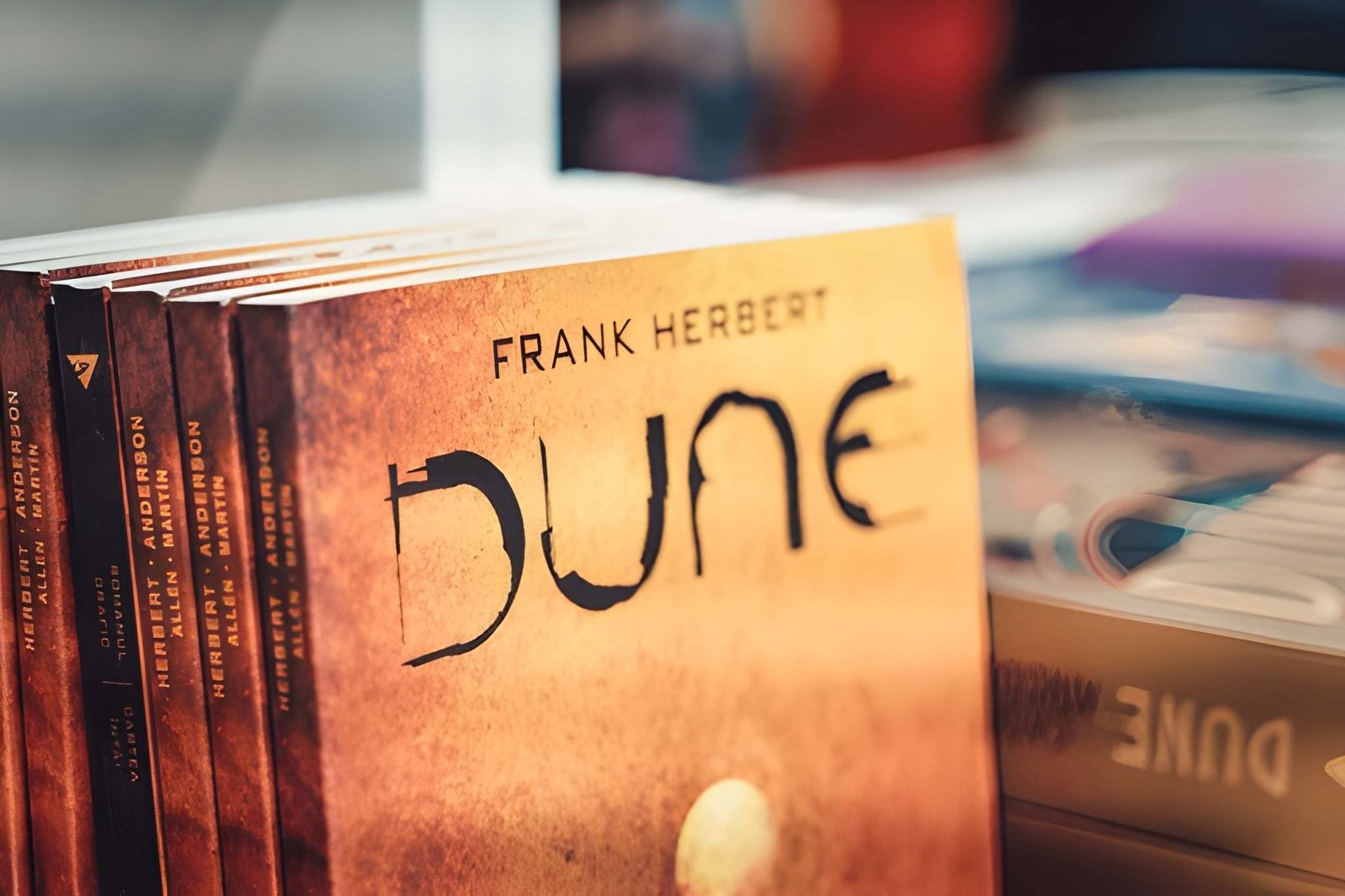
Frank Herbert’s Dune is not just a science fiction novel. It is a fully realized civilization — a work Arthur C. Clarke described as the Lord of the Rings of science fiction. Published in 1965 after six years of research and planning, it introduced readers to a desert planet with its own ecology, religion, politics, language, economy, and mythology — all of it interlocking, all of it internally consistent, none of it explained in the way most authors would reach for.
Sixty years later, it remains the bestselling science fiction novel of all time. Denis Villeneuve’s two-part film adaptation brought it to a new generation, and the conversation around its craft — how Herbert built something that massive, that coherent, and that emotionally alive — has never been more relevant for writers.
This guide breaks down the specific techniques behind Dune’s enduring power and shows you how to apply them to your own epic fiction.
Understand What Kind of Book Dune Actually Is
Before attempting to write in this tradition, you need to understand what Dune is doing beneath its surface. It is not primarily a space adventure. It is not a hero’s journey in any straightforward sense — Herbert was deeply skeptical of hero worship, and the novel’s most challenging theme is the danger of charismatic leaders and the people who surrender their judgment to them.
Dune is a systems novel. Everything in it — the ecology of Arrakis, the economics of spice, the political structure of the Imperium, the Bene Gesserit breeding program, the Fremen culture — is a system, and the novel’s drama emerges from the collision of those systems. Herbert builds scenes around conceptual tensions: ecology versus politics, religion versus power, individual will versus historical forces larger than any one person.
If you want to write a book like Dune, you are not writing a story that happens to have interesting worldbuilding. You are building a world where the story could not exist anywhere else — where setting and theme are inseparable.
Start With a Central Idea, Not a Plot
Herbert did not begin Dune with a story. He began with a fascination — a magazine research project about sand dunes in Oregon that he never finished, which sparked five years of obsessive research into desert ecology, water conservation, political power, and religious prophecy.
The lesson for writers is foundational: the most durable epic fiction is built from the inside out, not the outside in. You need a core idea that is generative — one that keeps producing implications the longer you think about it.
Ask yourself:
- What single premise, if taken seriously, would change everything about how a society functions?
- What natural or technological constraint would reshape culture, religion, economics, and conflict simultaneously?
- What question about human nature — power, faith, survival, identity — do you want the entire novel to explore?
For Herbert, that generative premise was ecology. The harsh desert environment of Arrakis didn’t just provide a backdrop — it was the cause of the planet’s culture. The sandworms produced the spice. The spice enabled interstellar navigation. The ecology made the Fremen who they were. Every element traced back to the same root premise.
Build your world from a premise that works the same way: one idea that ramifies outward into every corner of your story world.
Build a World Where Environment Shapes Everything
One of Dune’s most instructive worldbuilding lessons is the relationship between environment and culture. Herbert realized that environment is a huge shaping factor for culture — and he followed that logic to its most specific, detailed conclusions.
The Fremen don’t cry for their dead, because tears waste water. They wear stillsuits that reclaim the body’s moisture. They measure wealth in water rather than currency. Every cultural practice, social ritual, and belief system traces back to the logic of survival in an environment of extreme scarcity.
The harsh yet mesmerizing landscape of Arrakis becomes an integral part of the story — a character even more important than Paul Atreides himself. Dune simply wouldn’t exist without Dune.
To apply this in your own worldbuilding:
- Define your world’s dominant environmental or physical constraint
- Ask how that constraint shapes the economy — what is scarce, what is abundant?
- Ask how that scarcity shapes social hierarchies — who controls the scarce resource?
- Ask how those hierarchies shape religion — what does the culture worship, fear, and mythologize?
- Ask how that religion shapes individual psychology — what does your protagonist believe before the story forces them to question it?
Each step should follow logically from the one before. If your answers feel arbitrary or disconnected, the worldbuilding will feel that way too.
Research Obsessively Before You Write a Word
It is clear from reading Dune that a ridiculous amount of research went into it. Herbert spent five years in research before writing, building extensive files on desert ecology, political history, religion, and psychology.
This is not incidental to Dune’s quality. It is the foundation of it. The reason the world feels real is that Herbert understood it from first principles — not just the surface details, but the underlying systems that would produce those details.
For your own epic fiction, research should precede worldbuilding, not follow it. Identify the real-world analogs for your story’s central systems:
- If your world has a single planet-controlling resource, study the political history of oil
- If your story involves a secretive religious order, study the history of mystery cults and religious power structures
- If your protagonist is a reluctant messiah, study the sociology of prophetic movements and charismatic leadership
- If your world has a colonized indigenous population, study the history of colonialism and resistance movements
Herbert did all of these things. The Fremen are partly inspired by the Bedouin. The Spacing Guild reflects the medieval church’s monopoly on Latin literacy. The Bene Gesserit echo the political influence of female religious orders in Catholic history. None of this makes Dune derivative — it makes it grounded.
Create Political Complexity Without Simplifying Into Good vs. Evil
One of Dune’s most significant departures from conventional science fiction is its refusal to offer a clean moral framework. The Harkonnens are brutal, but the Atreides are not innocent. Paul’s victory over the Emperor is simultaneously the beginning of a religious war that will kill billions. Herbert forces readers to hold the complexity rather than resolving it.
Aim for intellectual density and moral ambiguity: scenes should reward re-reading. Prioritize cause-and-effect plausibility — what seems inevitable in your world should feel earned by prior constraints.
To build political complexity in your own epic:
- Give every faction a legitimate grievance. The reader should understand why each power wants what it wants, even when their methods are monstrous.
- Make your protagonist’s victory costly. Every gain should create new problems. Power is always double-edged in systems this large.
- Avoid the Dark Lord structure. A single evil villain who can be defeated to restore order is the antithesis of how Dune works. The systems are the antagonist.
- Let ideology be sincere. Characters in Dune genuinely believe in their religions, their political philosophies, and their historical destinies — even when those beliefs are manipulated or false.
Write a Protagonist Who Is Both Exceptional and Deeply Compromised
Paul Atreides is one of the most complex protagonists in science fiction precisely because his extraordinary gifts are also the source of his tragedy. He can see the future — and what he sees is a holy war in his name that he cannot prevent. His power is not a solution. It is a burden, a trap, and ultimately a catastrophe.
This is a more sophisticated protagonist model than the standard chosen-one archetype. Herbert is deliberately interrogating the messianic narrative even as he appears to be deploying it.
For your own protagonist in Dune-style epic fiction:
- Give them a power or gift that creates as many problems as it solves
- Make their exceptional qualities inseparable from their flaws — Paul’s prescience and his political training make him a revolutionary leader and a dangerous one
- Let them be aware of the machinery working on them — Paul knows the Bene Gesserit have shaped the Fremen’s expectations of a messiah, and he uses that knowledge deliberately
- Resist the clean redemption arc — characters this embedded in systems larger than themselves cannot simply choose their way to a satisfying resolution
Use Epigraphs and Secondary Texts to Build Historical Depth
One of Dune’s most distinctive structural techniques is its epigraphs — each chapter opens with a quote from an in-world document: Princess Irulan’s historical writings, Fremen proverbs, philosophical treatises from characters in the story. These serve multiple functions simultaneously.
They tell the reader that this world has a history that precedes and will outlast the events of the novel. They distribute exposition without interrupting the narrative. They create dramatic irony — readers often know from the epigraph what a scene’s long-term consequences will be before the scene begins. And they establish the world’s intellectual texture, signaling that this is a civilization with its own scholarship, its own recorded wisdom, its own contested interpretations of history.
Re-read Dune with attention to structure and note how epigraphs, documents, and interior aphorisms distribute exposition.
You don’t need to use epigraphs to achieve this effect. But you do need some mechanism for conveying that your world has depth behind the narrative — that the story takes place inside a history, not at the beginning of one.
Handle Exposition Through Action and Implication
One of the most common failures in epic worldbuilding is what writers call the infodump — pages of explanation about how the world works that grind the narrative to a halt. Herbert solved this problem with a technique that remains one of the craft’s best lessons: when you have to convey as much information as Dune does, you need to combine your exposition with action.
In an early scene, Paul’s combat training against mannequins reveals both his skill level and his Atreides heritage. The Gom Jabbar test conveys the nature and power of the Bene Gesserit, Paul’s own exceptional qualities, and the political dynamics of his family — all in a single scene of high tension where the exposition is inseparable from the stakes.
Practical rules for exposition in epic fiction:
- Never explain what you can demonstrate
- Put the worldbuilding detail inside the moment of the highest stakes
- Let characters argue about, misunderstand, or disagree with the exposition — conflict carries information more naturally than narration
- Trust the reader to catch up — Herbert regularly introduces terms without defining them, letting context do the work over multiple scenes
Build Languages, Terminology, and Naming Systems
Herbert’s world is extremely complex, with detailed history, politics, warring factions, economics, and different religions all incorporated into the story — and his naming and language systems reinforce that complexity at every level.
The Fremen have Arabic-influenced names and terminology that ground them in a real-world cultural tradition. The CHOAM corporation, the Great Houses, the Bene Gesserit — each name carries connotations that inform the reader about the faction’s nature without explanation.
You don’t need to construct full languages (that is, Tolkien’s territory). But your naming system should be internally consistent: names within the same culture should share phonetic patterns, word roots, or structural similarities that signal shared origin. Inconsistent naming — one culture with Anglo-Saxon names, Latin names, and Japanese names all mixed together — breaks the reader’s sense of coherent worldbuilding.
Final Thought: Earn the Scope
The greatest risk in attempting epic fiction at Dune’s scale is ambition without discipline. Herbert spent six years building before he wrote. The scope of his novel is earned by the depth of its foundation — every apparently small detail (a stillsuit, a water ring, a Fremen greeting) connects to the larger systems beneath it.
If worldbuilding isn’t influencing character decisions or plot, it may be better left out. The discipline is not just in what you add but in what you cut. Dune is dense, but nothing in it is arbitrary. Every element earns its presence by connecting to something larger.
Build your world with that same logic — from the ecology up, from the premise outward, from the research through the politics into the soul of your characters — and you will have something that, like Dune itself, could not exist anywhere but in the world you created.
