

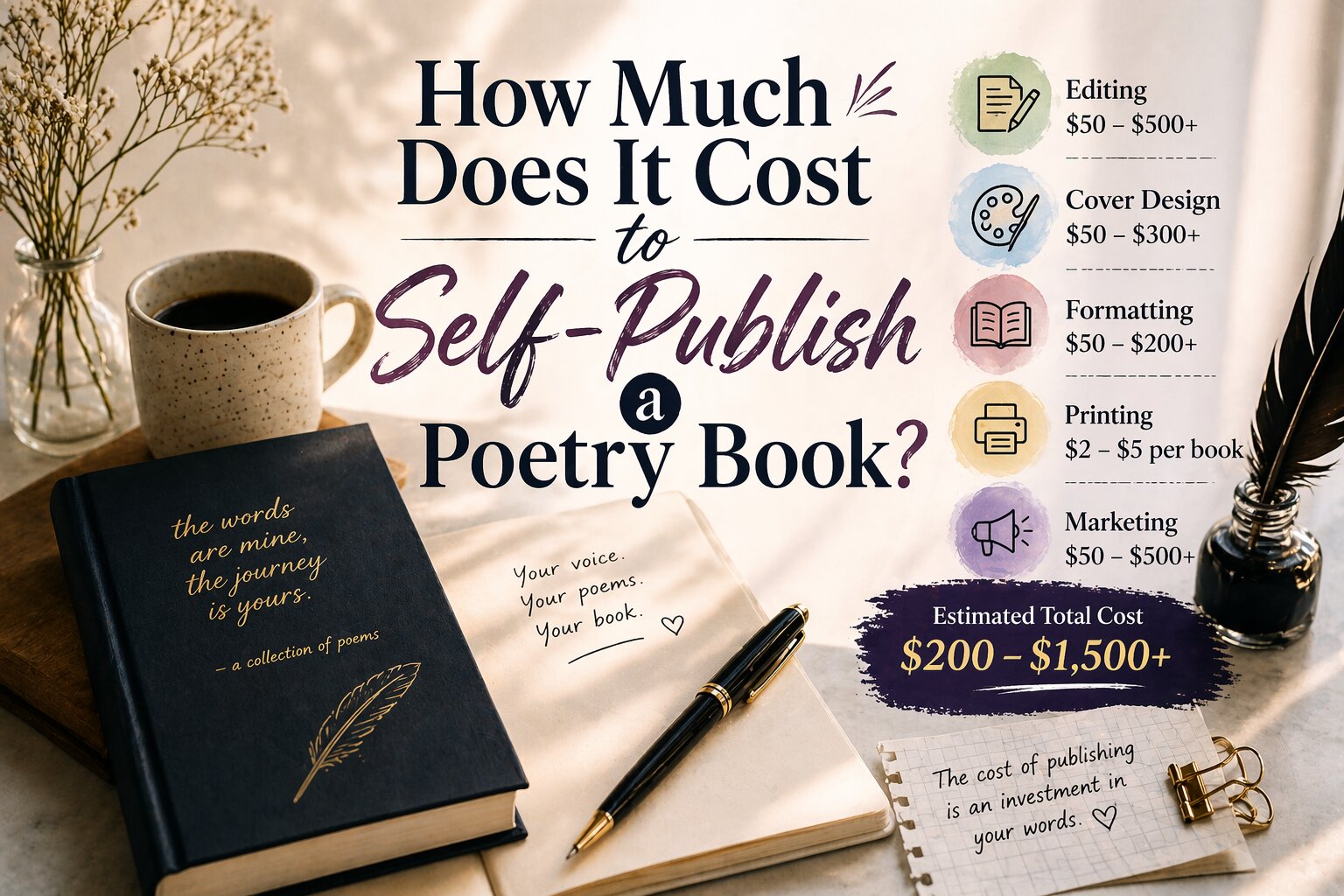
The honest answer: anywhere from $100 to $3,000+, depending on your goals, your skills, and how professional you want the finished product to be. Here’s exactly where the money goes — and where you can save without cutting corners that matter.
Poetry is one of the most self-publishing-friendly formats in all of literature. Collections are shorter than novels, require less developmental editing, and cost less to print. Yet many poets arrive at the self-publishing process without a clear budget and end up either overspending on services they didn’t need or underspending on the ones that actually determine whether readers take their book seriously.
This article gives you a complete, honest breakdown of every cost involved in self-publishing a poetry book in 2025 — from the expenses you can skip entirely to the ones worth every dollar. It also covers what your realistic total investment looks like at three different budget levels, and what you should prioritize if you’re working with limited funds.
The Short Answer: Three Budget Tiers
Before the detailed breakdown, here’s the practical summary most guides bury at the bottom:
Budget Tier 1 — Bare Minimum ($0–$200) You handle everything yourself: writing, editing, formatting, cover design. You publish to Amazon KDP for free using their free ISBN and cover tools. This is viable for poets publishing for family, friends, or a small personal audience. The product will likely look self-published to a trained eye.
Budget Tier 2 — Serious Indie ($300–$1,000) You invest in the two areas that most affect reader perception: a professional cover design and a round of copyediting or proofreading. You still handle formatting yourself or use free tools, and you use KDP’s free ISBN or purchase your own. This is the sweet spot for most first-time poets publishing independently.
Budget Tier 3 — Professional Release ($1,000–$3,000+) You invest in professional editing, professional cover design, professional interior formatting, your own ISBNs, distribution through both KDP and IngramSpark, and some level of book marketing. This is the level required if you want your collection reviewed, stocked in bookstores, or treated as a serious literary publication.
Most indie poets publishing their first collection land somewhere between Tier 1 and Tier 2. Let’s look at exactly what each cost category involves.
Cost Breakdown: Every Expense You’ll Encounter
1. Editing — $0 to $800
Poetry editing is different from novel editing. You’re not paying for developmental structural editing at novel rates. What you need for a poetry collection is:
Beta readers and workshop peers ($0): The most valuable editorial feedback for poetry often comes from other poets — writing groups, MFA cohorts, online poetry communities, or trusted readers. Many poets publish their first collection after years of workshop feedback, which means the poems are already heavily refined before they spend a dollar on professional editing.
Proofreading ($100–$400): A proofreader checks spelling, punctuation, consistency of formatting choices (en dashes, em dashes, spacing, stanza breaks), and catches errors that affect the professional appearance of the final book. For a 60–80 page poetry collection, expect to pay around $100–$300 from a freelancer on platforms like Reedsy or Upwork.
Copy editing ($200–$800): A copy editor works at the sentence and line level — not to change your poetic voice, but to catch inconsistencies, factual errors, and formatting issues that a proofreader might miss. For poetry specifically, a copy editor should be familiar with the genre and understand that intentional rule-breaking is part of the craft.
What to skip: Developmental editing for poetry is rarely necessary and almost never worth the cost for a debut collection. Poetry collections don’t have the structural plot architecture that developmental editing is designed to address. If your collection needs substantial reorganization or curation help, that’s better served by a poetry manuscript consultant or a trusted peer reader.
Competitor gap: Most articles lump poetry into their general book editing cost figures (which are built around 70,000+ word novels). A poetry collection of 40–80 pages requires significantly less editing time than a novel, making per-word editing rates misleading. Always ask editors for a project quote based on page count, not word count.
2. Cover Design — $0 to $600
Your cover is the single most important marketing asset your poetry book has. It is what a reader sees on Amazon before they read a word of your poems. Poetry collections compete aggressively on visual identity — literary aesthetics matter enormously to the audience.
DIY with Canva or similar tools ($0–$15/month): If you have a good eye for design, Canva’s free tier includes templates and basic design tools. A clean, typographically strong cover can absolutely be created by a non-designer if they understand what makes poetry cover design work: strong typography, intentional whitespace, restrained color palettes, and an image or texture that resonates with the collection’s themes. Canva Pro costs around $15/month if you need premium assets.
Premade covers ($50–$200): Several services sell premade book cover designs that can be customized with your title and author name. This is one of the best value options for poets — you get a professional-grade design at a fraction of the cost of custom work. Sites like The Book Cover Designer and Damonza offer premade options specifically for literary fiction and poetry.
Custom cover design from a freelancer ($200–$600): A professional designer who understands literary aesthetics and book cover conventions will create something bespoke to your collection. On Fiverr, you can find designers at a wide range of prices, but be cautious of the cheapest options — book cover design is a specialized skill. Budget at least $200 for quality custom work, and review a designer’s portfolio carefully before hiring.
The most important advice about cover design: Do not skip this. The cover is where readers make their first judgment about whether your book looks like it belongs in a bookstore or looks like a self-published vanity project. If your budget is limited and you can only invest in one professional service, let it be the cover.
3. Interior Formatting — $0 to $200
Interior formatting for poetry is actually one area where poets have a real advantage over novelists. Poetry collections often benefit from spare, minimal design — clean typography, generous margins, and consistent stanza formatting. This is achievable with free tools.
Free tools: Reedsy’s free book editor exports clean, formatted files for both print and ebook. Atticus ($147 one-time purchase) is a popular paid option that handles both interior formatting and ebook conversion. Microsoft Word with a formatting template (available free from IngramSpark and KDP) works for basic poetry collections.
Professional formatting ($100–$200): If your collection includes visual poems, concrete poetry, unusual spatial arrangements on the page, or significant typographic experimentation, hire a professional formatter. Standard typesetting programs like InDesign are required for complex layouts that Word and consumer tools can’t reliably handle. For straightforward lyric poetry, professional formatting is a nice-to-have, not a necessity.
Note on interior design: Poetry collections often look better with a slightly larger trim size (6×9 inches is common) and generous line spacing that lets the poems breathe on the page. These are choices that affect cost at printing — more white space means more pages, which means slightly higher printing costs per copy. Consider this when choosing your trim size.
4. ISBN — $0 to $295
An ISBN (International Standard Book Number) is a unique identifier that your book needs to be sold through retailers, stocked in libraries, and distributed internationally. Here’s the honest breakdown of your options:
Free ISBN from Amazon KDP: KDP provides a free ISBN if you distribute exclusively through Amazon. The catch: Amazon is listed as your publisher of record, not you. This is fine if you only care about Amazon sales and don’t need your book stocked in independent bookstores or libraries.
Free ISBN from IngramSpark: IngramSpark similarly offers a free ISBN for books distributed through their platform. Same caveat applies — they become the publisher of record.
Your own ISBN from Bowker (US): If you want to control your publishing imprint — meaning your own press name appears as publisher — you need to purchase your ISBN through Bowker, the only official US ISBN agency. A single ISBN costs $125. A block of 10 costs $295. Since each format (paperback, hardcover, ebook) requires its own ISBN, the 10-pack is almost always the better investment if you plan to publish multiple formats or future books.
The practical recommendation for poets: If you’re publishing your first collection primarily to build a readership and aren’t focused on bookstore distribution, use KDP’s free ISBN and save the money. If you want your book treated as a legitimate literary publication, want it stocked in independent bookstores, or are building an author platform, buy your own ISBNs.
5. Publishing Platform Fees — $0 to $50
Amazon KDP: Completely free to upload. Amazon takes a percentage of each sale as royalties, but there are no upfront setup fees. For a paperback poetry collection priced at $12–$15, you can earn 40–60% royalties, with printing costs deducted per sale.
IngramSpark: Currently charges around $49 per title for setup, with a $25 fee for file revisions after the initial free revision window. IngramSpark is essential if you want your book available to independent bookstores and libraries through their network of over 40,000 retailers. Most serious indie poets use both KDP and IngramSpark together — KDP for Amazon sales and IngramSpark for wider distribution.
Barnes & Noble Press: Free to upload, no setup fees. A solid option for reaching B&N’s customer base directly.
The dual-platform strategy: Publishing simultaneously on KDP and IngramSpark is the professional standard for indie authors who want broad distribution. The $49 IngramSpark fee is worth paying if bookstore reach matters to you.
6. Printing Costs — $0 upfront (or $2–$6 per copy with POD)
If you use print-on-demand (POD) through KDP or IngramSpark, you pay nothing up front. Printing costs are deducted automatically from your royalties each time a copy is sold. For a standard black-and-white paperback poetry collection of 80–120 pages, printing costs typically run $2–$4 per copy through KDP.
Proof copies: Always order at least one physical proof copy before going live. This lets you check the formatting, cover bleed, spine alignment, and print quality. A proof typically costs $5–$10 plus shipping.
Author copies for events: If you want physical copies to sell at readings, events, or to give as gifts, you can order author copies at cost (printing price without retail markup). For a 100-page poetry paperback, this is usually around $3–$5 per copy before shipping.
Offset printing (bulk): If you’re confident in your sales demand and want a lower per-unit cost, traditional bulk printing through a printer like 48 Hour Books or IngramSpark’s offset option starts to become cost-effective at 250–500 copies. At that scale, you might pay $2–$3 per copy, but you’re carrying inventory upfront. For most debut poetry collections, POD is the safer and smarter default.
7. Copyright Registration — $45 to $85 (optional)
Your work is automatically protected by copyright the moment you write it. However, formally registering with the US Copyright Office (copyright.gov) creates a public record, gives you stronger legal standing in infringement cases, and allows you to pursue statutory damages if someone copies your work. Registration costs $45–$85, depending on whether you register online and how many works you include in a single submission.
This is optional but worth considering for collections you’re serious about protecting — especially if your poems have already appeared in literary journals and you’ve already been building a public writing profile.
8. Marketing — $0 to $1,000+
This is the area most first-time poets either ignore entirely or wildly overspend on without a clear strategy. The honest truth about poetry marketing is that most poetry books sell on the strength of the poet’s platform — their presence in literary journals, their community connections, their social media following, their performance history — rather than on paid advertising.
Free and low-cost marketing:
- Social media presence (Instagram is particularly strong for poetry)
- Submitting individual poems to literary journals before publication (builds credibility and audience)
- Advance review copies (ARCs) sent to poetry reviewers and book bloggers
- Local event marketing — readings at bookstores, coffee shops, libraries
- A professional author website ($50–$200/year for hosting and domain)
Paid advertising: Facebook and Instagram ads for poetry books rarely generate strong ROI for debut collections without an existing audience. Unless you have a clear strategy and some platform to build on, paid ads are not where a first-time poetry collection budget should go.
The honest caveat: Poetry sells to poetry readers, and poetry readers discover books primarily through other poets, literary journals, and community word-of-mouth rather than through algorithmically targeted ads. Invest your time in the literary community before your book launches. That investment pays better dividends than any marketing spend.
The Full Budget Picture: Three Realistic Scenarios
Scenario 1: The No-Budget Launch ($0–$150)
- Editing: Self-edited with peer feedback from a writing group ($0)
- Cover: Designed in Canva using a paid template ($15)
- Formatting: Reedsy’s free tool ($0)
- ISBN: KDP’s free ISBN ($0)
- Platform: Amazon KDP only ($0)
- Proof copy: 1 copy at printing cost + shipping ($12–$18)
- Marketing: Social media and email list ($0)
Total: ~$30–$50
This is a viable launch for a poet publishing to an existing community of readers. The book won’t compete visually with traditionally published collections, but it exists, it’s available, and it’s yours.
Scenario 2: The Serious First Collection ($400–$800)
- Editing: Proofreading from a freelancer ($150–$250)
- Cover: Custom design from a vetted Fiverr or Reedsy designer ($250–$400)
- Formatting: Atticus or a free template ($0–$150)
- ISBN: Own ISBN from Bowker for print + ebook ($125–$250)
- Platforms: KDP + IngramSpark ($49 for IngramSpark setup)
- Proof copies: 2–3 copies ($30–$50)
- Marketing: Author website + ARC copies ($100–$200)
Total: ~$700–$1,100
This is the sweet spot for a poet who wants their collection to look professional, reach bookstores, and be taken seriously by reviewers. The investment is meaningful but not prohibitive.
Scenario 3: The Professional Release ($1,200–$2,500)
- Editing: Copy editing from a specialist poetry editor ($300–$600)
- Cover: Professional custom design ($400–$600)
- Interior formatting: Professional typesetting, especially for complex layouts ($150–$300)
- ISBNs: Block of 10 from Bowker ($295)
- Platforms: KDP + IngramSpark + B&N Press ($50–$100 in setup)
- Proof copies and author event copies ($100–$200)
- Copyright registration ($65)
- Marketing: Website, ARC distribution, limited advertising ($300–$500)
Total: ~$1,600–$2,600
This is appropriate for a poet with a serious literary profile, a book that’s been submitted to journals, and an expectation of review coverage and bookstore placement.
What to Prioritize If Your Budget Is Tight
If you can only spend money on one thing, spend it on the cover. Readers make instant judgments based on visual presentation, and an amateur cover signals to browsing buyers that the interior may not be worth their time.
If you can spend money on two things, add a round of proofreading. Clean, error-free text is the baseline expectation readers bring to any book, regardless of price. One persistent typo on the first page of a poetry collection can cost you the reader’s trust before you’ve had a chance to earn it.
Everything else — interior formatting, ISBNs, IngramSpark distribution, marketing spend — can be built up over time or scaled to your actual budget without affecting the core reading experience.
One Cost That Isn’t Money: Your Time
Self-publishing requires a significant investment of time that most cost breakdowns don’t account for. Learning formatting software, navigating KDP and IngramSpark’s upload requirements, designing or sourcing a cover, marketing on social media, building an email list, coordinating with reviewers and bookstores — all of this is real work that takes real hours.
The financial case for hiring professionals isn’t just about quality. It’s also about time. A poet who spends 40 hours learning cover design software instead of writing poems has made a trade that may not serve their long-term creative output. Know where your time is best spent, and spend money to protect those hours when you can afford to.
Quick-Reference Summary
How much does it cost to self-publish a poetry book? Between $0 and $3,000+, depending on the services you hire and your distribution goals. Most first-time poets spend between $300 and $1,000 for a professional-quality release.
Core costs:
- Editing (proofreading to copy editing): $0–$800
- Cover design: $0–$600
- Interior formatting: $0–$200
- ISBN (Bowker, single): $125 | Block of 10: $295 | Free through KDP/IngramSpark (with restrictions)
- Publishing platform setup: $0 (KDP) | ~$49 (IngramSpark)
- Printing (POD): $0 upfront; $2–$6 per copy deducted from royalties
- Copyright registration: $45–$85 (optional)
- Marketing: $0–$1,000+
Where to spend your limited budget: Cover design first, then proofreading. These two investments have the highest impact on reader perception.
Platform recommendation: Publish on Amazon KDP for free, then add IngramSpark ($49 setup) for bookstore and library distribution. Use KDP’s free ISBN if Amazon-only distribution is acceptable; buy your own from Bowker if you want to control your publisher imprint.
What makes poetry different from novels in cost: Poetry collections are shorter (typically 40–120 pages), require less editing time, cost less to print, and rarely need developmental editing. General book publishing cost estimates built around 70,000-word novels are not accurate guides for poetry collections.
